Specialist leadwork in Swindon from £200. Code 4 milled lead flashings, valleys, flat bays and chimney dressings. Traditional dressing techniques with flexible sealant pointing. 30–50 year expected lifespan. Call 0179 329 7084 for a free quote.
Leadwork
Leadwork Specialists in Swindon
Lead is the most durable and versatile roofing material available. Properly specified and dressed, code 4 milled lead sheet lasts 30–50 years in exposed positions and longer in sheltered ones. It is the material of choice for flashings, valleys, flat roof bays, chimney abutments, and any junction where different roof surfaces meet. In Swindon, where thermal cycling and wind-driven rain test every junction relentlessly, getting the leadwork right is the difference between a watertight roof and one that leaks at every change of weather.
Lead Flashings in Swindon
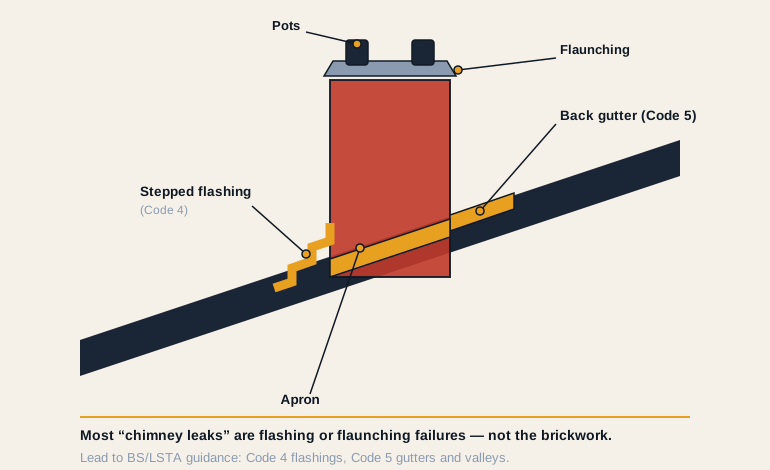
Step flashings where a roof meets a wall. Apron flashings at the base of chimney stacks. Cover flashings over the tops of soakers. Back gutters behind chimney stacks. Each type requires specific dressing technique, correct code weight, and proper chase cutting and pointing. We use code 4 milled lead for all standard flashings — heavy enough for durability, workable enough for clean dressing. Chase cuts are sealed with flexible Geocel sealant rather than hard mortar that cracks from thermal movement within two years.
Lead Valleys
Valleys are the internal angles where two roof slopes meet. They channel the combined water flow from both slopes and must handle peak rainfall without overflow. We line valleys in code 4 lead with 75mm minimum side laps under the tiles, welted edges to prevent capillary creep, and a central drip channel that directs water flow. Valley failures are one of the most common leak sources on Swindon roofs with complex geometry — Victorian properties in Old Town and Edwardian villas with multiple roof junctions are particularly prone.
Why Swindon Leadwork Fails
The Wiltshire plateau creates wider daily temperature swings than sheltered towns. Lead expands and contracts with every cycle — code 4 lead expands approximately 1.5mm per metre for every 10 degree temperature change. Over thousands of cycles, the repeated movement causes fatigue cracking at fold lines, splits at chase joints, and lifting at free edges. North-facing and west-facing elevations fail fastest because they experience the widest temperature range between cold overnight temperatures and afternoon sun. We design every piece of leadwork with expansion joints and adequate fixings to accommodate this movement.
Lead Bay Roofs and Flat Areas
Bay window tops, small flat areas between roof junctions, and porch roofs are often covered in lead. These areas require careful attention to falls — lead must drain positively with a minimum 1:60 fall to prevent ponding. Joints between lead sheets use welted seams rather than solder, which cracks from thermal movement. Each sheet is limited to 1.5m maximum length to control thermal expansion, with expansion joints at every seam.
Guide Prices — Free Quotes Available
Lead flashing repair
£200–£500
Lead valley re-line (per metre)
£80–£120
Lead flat roof/bay (per m²)
£120–£180
Complete chimney lead package
£400–£900
Expert Detail
Lead Grades and When to Use Each
Lead sheet is graded by code number indicating thickness. Code 3 (1.32mm) is too thin for external roofing in Swindon conditions — it fatigues quickly from thermal cycling. Code 4 (1.80mm) is the standard specification for flashings, valleys and flat areas — the right balance of durability and workability. Code 5 (2.24mm) is used for exposed positions with extreme wind loading or areas subject to foot traffic. Code 6 and above are specialist applications. We use code 4 as standard on all Swindon work and upgrade to code 5 only where the exposure genuinely demands it.
Traditional Lead Dressing Techniques
Lead roofing is a craft skill that requires understanding of how the material behaves. Lead is bossed — shaped by hammering over a form — rather than folded sharply, which creates stress points that crack over time. Joints between sheets use welted seams — interlocking folds that create a mechanical waterproof bond without solder, which cracks from thermal movement. Each sheet is limited to 1.5m maximum in any direction to control thermal expansion. These techniques have been used for centuries because they work. Modern sealants and adhesives supplement but do not replace traditional lead dressing.
Further Detail
Lead Theft Prevention
Lead roofing is valuable scrap metal and unfortunately a target for theft, particularly on unoccupied or secluded properties. There are several deterrent options we can advise on. SmartWater or SelectaDNA forensic marking makes stolen lead traceable. Tamper-evident fasteners on accessible lead flashings alert you to interference. Lead substitute products like Ubiflex provide a non-metal alternative for lower-risk areas while maintaining waterproof performance. For high-risk locations, we can specify lead-effect GRP that looks identical to lead but has no scrap value. We advise on the appropriate level of protection for each installation based on the property location and visibility.
More Information
When to Repair vs Replace Lead
Not every lead flashing problem requires complete replacement. A hairline crack at a single fold line can be repaired with a patch of matching lead dressed over the crack and sealed with compatible sealant. A lifted edge where the pointing has failed can be re-dressed and re-pointed without removing the existing lead. However, if the lead is cracked at multiple points, if it has become paper-thin from corrosion, if the original dressing was poor and water is getting behind the lead rather than over it, or if the lead has been patched repeatedly already, replacement is the better investment. New code 4 lead properly dressed will last 30-40 years. Repeated patching of deteriorated lead is money wasted on a material that has reached the end of its useful life. We assess honestly and recommend accordingly.
AccessAccess, Scaffolding & Permits
Access method depends on the specific job — ladder, tower scaffold or full scaffold. Always itemised in your quote. Scaffold is specified for: work above single-storey height, multi-day jobs, chimney and ridge access — always itemised in your written quote, never a hidden extra.
Pavement scaffold and skip permits go through Swindon Borough Council. On restricted streets in Old Town, the Railway Village and parts of Rodbourne, we coordinate access to minimise disruption. Allow a few working days for permit processing.