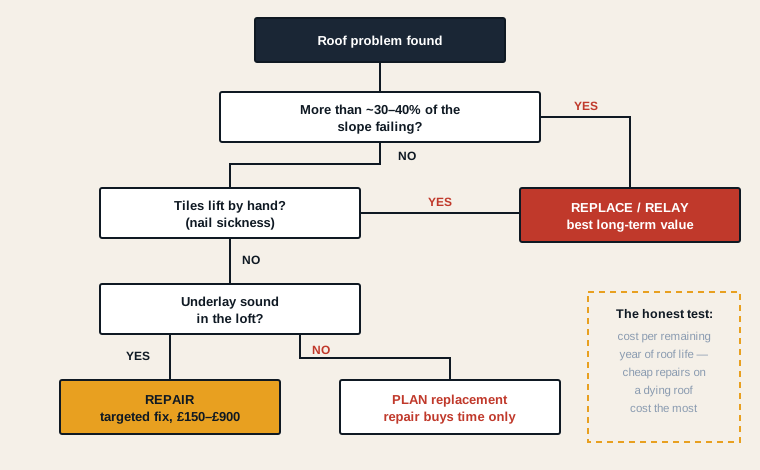
The honest decision framework — when repair saves money, when it wastes it, and how to tell the difference on Swindon's housing stock.
Repair is the right call when the damage is genuinely localised and the rest of the roof system is sound. A storm displaces three tiles on an otherwise secure roof — that is a repair. A chimney flashing cracks from thermal cycling but the tiles, felt and fixings are all intact — that is a repair. A gutter joint fails and needs resealing — that is a repair. The key test: can the roofer fix this area and leave confident that the surrounding roof will not fail within the next five years? If yes, repair.
On Swindon's post-war estates, the honest answer is often no. A repair on a nail-sick roof fixes one symptom while the cause — corroded fixings across the entire slope — continues to progress. The tiles we fix today are held by the same failing nails as the tiles that will slip in the next storm. This is not an upsell — it is physics.
The NFRC recommends replacement when more than approximately 30–40% of fixings across the roof area have failed. At this point, the system is failing, not just individual tiles. Sequential repairs become a false economy: each emergency call costs £150–£300, the damage between calls (water ingress through exposed felt) causes timber rot that adds to the eventual re-roof cost, and the stress of repeated failures disrupts your life.
The cost-per-remaining-year calculation makes it clear. A re-roof at £5,000 lasting 50+ years costs £100 per year. Three repairs per year at £250 each for the 5 years until the roof finally fails cost £3,750 total — plus the £5,000 re-roof at the end, plus £1,000–£2,000 in timber damage from water ingress between repairs. Total: £9,750–£10,750 versus £5,000. The cheapest repairs on a dying roof cost the most.
Swindon's post-war estates — Penhill (1955–62), Pinehurst (1930s–60s), Park North (1960s–70s), Covingham (1970s–80s), Walcot (1960s–70s), Eldene (1970s–80s), Liden (1970s), Nythe (1970s–80s) — were all roofed with concrete interlocking tiles on galvanised steel nails. These nails have a lifespan of 30–50 years. The oldest estates are now 60–70 years past installation. The youngest are 40–50 years in. Every estate is at or past the nail failure point.
This does not mean every house needs a new roof today. Corrosion rates vary by orientation (west-facing corrodes faster from Atlantic weather), ventilation (damp lofts accelerate corrosion), and original nail quality. An inspection tells you where your specific property sits on the failure curve — and whether repair or replacement is genuinely the right call for your house, not just your postcode.
Flat roof repair-vs-replace follows a different logic. If the membrane is still flexible, the deck is dry and firm, and the leak is from a single identifiable point (a lifted upstand, a blocked outlet), a £200–£400 patch can give years more service. If the felt is brittle, the deck is swollen from moisture, or water ponds for more than 24 hours, the whole system needs replacing. GRP or EPDM replacement costs £800–£5,000 depending on size but gives 25–30 years of trouble-free performance. See our warm deck vs cold deck guide.
We would rather repair a roof that genuinely needs repairing than sell a replacement that is not yet necessary. Overselling a re-roof does not build the trust that keeps customers returning for 20 years. Equally, we will not patch a failing roof and take the money knowing the call will come again in three months. Our inspection report grades every element — good, fair, attention needed — and recommends the course of action that gives you the best value over the next decade, not just the cheapest price today.
NFRC Refurbishment Guide: "When more than 30% of fixings have failed across the roof area, sequential repair becomes uneconomic. Full replacement provides better long-term value and eliminates the cycle of emergency call-outs" (NFRC, 2023).
Call 0179 329 7084 for a free assessment. Inspection fee credited against any work booked.
0179 329 7084Three signs point to replacement: tiles lift by hand across the slope (systemic nail sickness), the felt underlay has perished when viewed from the loft, or you have had three or more repair calls within two years on the same roof area. Any one of these means the system is failing, not just the individual tile. See our inspection service for a definitive assessment.
It depends on the fixings and underlay, not the tiles. Concrete tiles from the 1960s–70s are often in excellent condition — the nails holding them are the problem. If the nails are sound and the felt is intact, targeted repairs are excellent value. If the fixings have corroded systemically, replacement is the better long-term investment.
NFRC guidance recommends full replacement rather than continued repair when more than approximately 30–40% of the fixings across the roof area have failed. Below this threshold, targeted repair is cost-effective. Above it, sequential repairs become a false economy because adjacent areas fail in every subsequent storm.
Repairs: £150–£900 per visit. A typical re-roof for a Swindon 3-bed semi: £4,500–£7,000. The break-even calculation: if repair costs over 3 years exceed 60% of a re-roof cost, replacement saves money and stress. See our repair cost and replacement cost guides.
Yes. Our roof inspections (£120–£250, fee credited against any work booked) give you a definitive answer. We grade every element and recommend the genuinely right course of action — whether that is a £200 repair or a £5,000 re-roof. We would rather keep a customer for 20 years than oversell one job.
Flat roof felt patches make sense when the rest of the membrane is still flexible and the deck is dry. If the felt is brittle, the deck is swollen, or water ponds for more than 24 hours, replacement with GRP or EPDM is the permanent fix. See our flat roof cost guide.
Yes. A new roof typically adds £10,000–£20,000 to a Swindon property's value — more than the cost of the work on most semis. It also removes a major concern for mortgage lenders and surveyors, making the property significantly easier to sell.
Last updated: August 2026
Consider a Swindon semi with developing nail sickness. Scenario A (repair): two repair calls per year at £250 average, totalling £5,000 over 10 years, plus the inevitable re-roof at year 8-10 when the system finally fails completely — another £5,000-£7,000. Total 10-year cost: £10,000-£12,000, plus the stress, disruption and internal water damage between repairs. Scenario B (replace now): £5,000-£7,000 for a complete re-roof with stainless fixings, breathable membrane and a 10-year workmanship guarantee. Total 10-year cost: £5,000-£7,000 with zero repair calls, zero water damage and zero stress. The numbers are unambiguous. The only question is whether your roof has genuinely reached the replacement threshold — and that is exactly what our inspection tells you.
A re-roof replaces every layer of the roof system: the tiles, the fixings, the underlay membrane, and the battens. It allows us to inspect and repair the structural timbers — rafters, purlins, wall plates — that are invisible beneath the old covering. It upgrades the underlay from perished bituminous felt to modern breathable membrane, eliminating loft condensation risk. It replaces corroded galvanised nails with A2 stainless that will never corrode. It allows insulation upgrades to current Building Regulations standards. No amount of tile-by-tile repair achieves any of these systemic improvements.
Call 0179 329 7084.
0179 329 7084